Notable Activity
Legislators generated quite a bit of activity this week, despite not being in session for long. The Senate met and adjourned on Monday, with the House meeting and adjourning on Tuesday. Disagreements between the two chambers, mostly stemming from differences on budget priorities, framed the dialogue around every bill. As a result, only four bills advanced for the governor’s consideration, leaving many legislative priorities unfinished.
The main points of focus revolved around Medicaid funding, justice and public safety changes, regulatory reform, and limited adjustments to state spending. While a few pieces of other legislation may have moved forward in committees, the standoff between the House and Senate meant there was little chance of legislation passing both chambers.
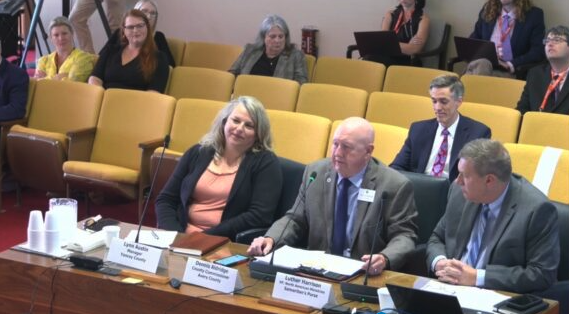
Amid legislative discussions, counties were well represented at the General Assembly this week, with Avery County Commissioner Dennis Aldridge and Yancey County Manager Lynn Austin testifying on Hurricane Helene recovery. Read more below about what they shared with legislators.
Passed Legislation
Justice & Public Safety
Following the killing of Iryna Zarutska, majority party leadership in both the House and Senate promised swift action to reform the judicial system to try and prevent similar tragedies from happening again. The resulting bill, House Bill 307 – Iryna’s Law, made numerous adjustments, including eliminating written promises to appear at court, modifying pretrial release laws, changing involuntary commitment procedures, providing funding for local Mecklenburg County assistant district attorneys, and modifying death penalty proceedings, including streamlining the appeals process and directing alternate forms of execution if necessary.
Regulatory Reform
House Bill 926 – Regulatory Reform Act of 2025 makes various regulatory changes across a wide range of topics, several of interest to county governments. Section 3 prohibits local inspection departments from charging permit holders for automatically failing inspections if the permit holder cancels an inspection with more than one business day’s notice. Section 18 exempts any State Construction Office project from local zoning or development regulation. Section 29 establishes that any vested rights obtained by permit or local government approval does not preclude the use or existence of other vested rights attached to the property. It also provides that if local governments with jurisdiction over a parcel fail to reach mutual agreement, the landowner may choose to follow the ordinances of the jurisdiction governing the majority of that parcel of land.
State Spending
House Bill 358 — Continuing Budget Operations Part II was the latest in mini-budgets passed to update state-level spending to match current needs. The highlight of the bill for counties was that it provided an additional $65 million in disaster relief: $55 million for the state match for Hurricanes Helene and Chantal, and $10 million for various other state agencies programs.
Legislation Discussed but Not Passed
Medicaid Funding & County Error Rates
Both the House and the Senate advanced their own legislation (Senate Bill 403 – Additional Medicaid Funds and Requirements and House Bill 562 Healthcare Investment Act) to fully fund Medicaid for the remainder of the fiscal year but could not come to an agreement on mutual language to pass into law. Both bills funded Medicaid at levels necessary to keep provider rates steady and services available, and both bills cut vacant positions from the North Carolina Department of Health and Human Services (NCDHHS) and other state agencies. Both bills empowered the state auditor to review all counties’ Medicaid eligibility procedures and error rates, though the House bill also required the auditor to review SNAP eligibility decisions in addition to Medicaid. The Senate drew on opioid settlement funds to close a $14 million funding gap, but that provision was not included in the House’s bill.
The largest differentiator between the two bills, and what is understood to be the cause for an impasse, is the Senate’s version includes an additional $200+ million for the planned North Carolina Children’s Hospital. The House’s version does not include that funding for the hospital and allocates those funds elsewhere.
As a result of the impasse, NCDHHS did not receive additional funds to operate Medicaid at current levels and, at the time of this writing, still intends to implement a 3% provider cut on October 1 which will be applied to local health departments and education agencies. NCDHHS will be providing detailed information to counties as the deadline approaches, and if the legislature decides to apply funding during future sessions, the reduction may be eliminated.
Helene Recovery Advocacy
Avery County Commissioner Dennis Aldridge and Yancey County Manager Lynn Austin were invited to testify this week at the Joint Legislative Commission on Government Operations Hurricane Response and Recovery Subcommittee, where they shared their counties’ progress toward recovering from Hurricane Helene and outlined their ongoing needs. Key topics included delays of federal assistance, continued debris removal, infrastructure repair and replacement, and the need for revenue replacement as counties continued to simultaneously fund recovery efforts and traditional county services.